
Accounting For NPOs –
Made Easy
Trusted by hundred of businesses



How We Can Help
Equipped to cater to the unique needs of your non-profit organization
Expense Management
Donation and Grant Tracking
Program Impact Reporting
Regulatory Compliance
Cashflow Forecasting
Grant and Loan Management
What Do We Do
The powerhouse of all
your non-profit financial needs.
The powerhouse of all your non-profit financial needs.
accounting services are customized to support your mission at every stage.
The AccountiPro Edge
We don’t just do your finances -
we help you build a sustainable financial system
guide your non-profit organization through every phase of your organization’s journey

Qualified & Trained Accountants

Industry-Grade Technology Stack

Cost-Effective Solutions

Flexible & Scalable Services
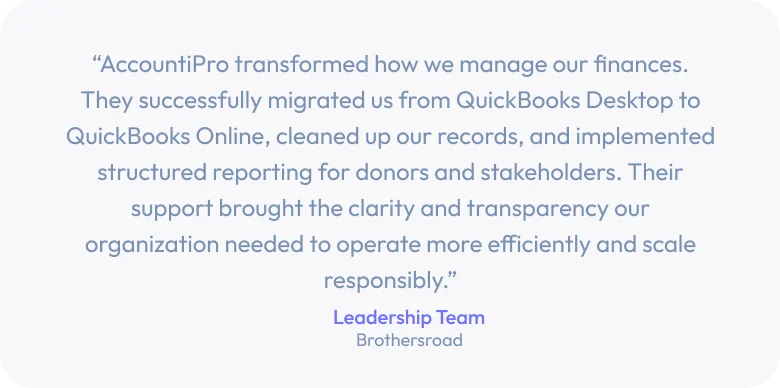
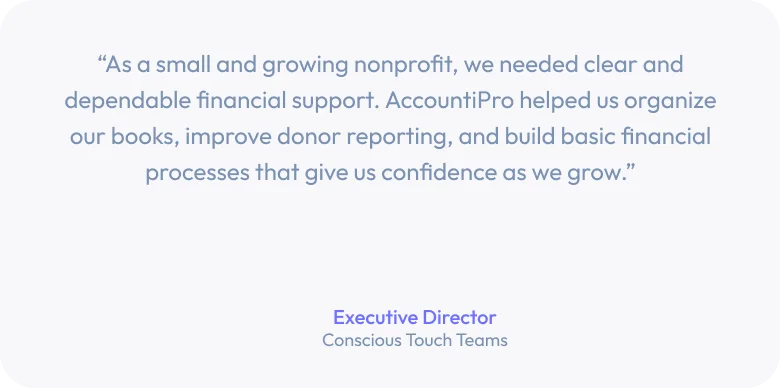
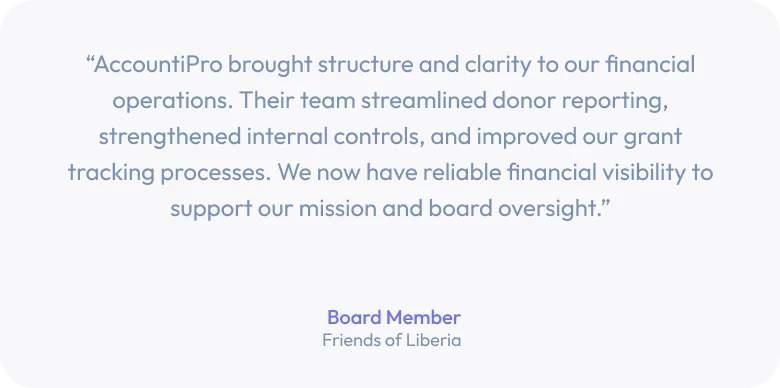
CLIENT FEEDBACK
We have promised
results,
and we have
proven them.
Still unsure about your accounting needs?
Talk to our specialized advisors
We’re just one
consultation away!
Bookkeeping For Non-Profit Organizations. Is it necessary?
What Does Ratio Analysis Tell You?
How Are Ratios Calculated?
-
Current Ratio = Current Assets ÷ Current Liabilities
Why is it necessary?
Because it gauges short-term liquidity, ideally exceeds 1.0 -
Quick Ratio = (Current Assets − Inventory) ÷ Current Liabilities
Why is it necessary?
It shows whether a business can immediately cover its short-term debts using only its most liquid assets. -
Debt-to-Equity Ratio = Total Debt ÷ Equity
Why is it necessary?
Because it measures financial leverage and long-term obligations. -
Return on Assets (ROA) = Net Income ÷ Average Total Assets
Why is it necessary?
Because it shows how productive assets generate profit. -
Return on Equity (ROE) = Net Income ÷ Shareholders’ Equity
Why is it necessary?
Because it indicates returns earned on invested capital. -
Asset Turnover Ratio = Net Sales ÷ Average Total Assets
Why is it necessary?
Because it measures asset efficiency in generating revenue.
Applications Of Ratio Analysis
- Liquidity ratios: show if you have enough funds to cover day-to-day expenses and emergencies.
- Leverage ratios: such as solvency ratios, help you understand if your non-profit organization can meet long-term commitments and maintain financial health.
- Efficiency ratios: reveal how quickly you use resources, such as how fast supplies are turned into meals or how quickly donations are put to use.
- Profitability ratios: measure how much of your funding is spent directly on your mission, helping you track impact and improve operations.
Why Non-Profit Organizations Should Use Ratio Analysis?
Our Certifications & Affiliations


FAQs
Non-profit accounting is how charities and organizations track the money they receive through donations or the amount they spend. It helps them stay organized, follow rules, and show donors and boards how their funds are being used to support the mission
Yes. Because non-profits don’t focus on making a profit, they focus on raising donations to further use that money to support a cause. This is why, instead of tracking profit and loss, they use fund accounting to keep track of where money comes from, like donations or grants, and how it is being used.
Yes, most non-profits follow GAAP, aka Generally Accepted Accounting Principles. These are the standard rules that help keep financial records clear, consistent, and trustworthy, especially for audits, grant reporting, or public transparency.
It is advisable to review your financials at least every month or every quarter, to stay up-to-date with your budget and spot issues early on. It is also a good practice to share reports with the board quarterly, so that everyone is informed and involved.
Non-profit organizations should use fund accounting to track money by purpose, keep their books updated regularly, review their budget and spending often, stay compliant with the tax filings, including IRS Form 990, keep clear records for donations and grants, and work with someone who understands non-profit rules.
Yes. Many non-profits choose to outsource bookkeeping to experts. It saves time, reduces mistakes, and helps you stay focused on your mission while professionals handle the numbers.
Documents, including, Chart of Accounts, Financial Statements, Tax Forms, and Budgets, are important for non-profit accounting.
Yes, it is very important. Accurate bookkeeping helps you track donations, grants, and expenses, stay ready for audits or compliance checks, and understand your organization’s financial health.
A current ratio of 1.0 is generally seen as healthy. It means your organization has enough resources to cover its short-term needs and remain financially stable.
Monitor ratios, including the program expense ratio (to see how much funding goes directly to your mission), the fundraising efficiency ratio (to track the cost of raising donations), and the current ratio (to ensure financial stability). These help you measure efficiency, impact, and sustainability.